Room Roast | The Frill of It All
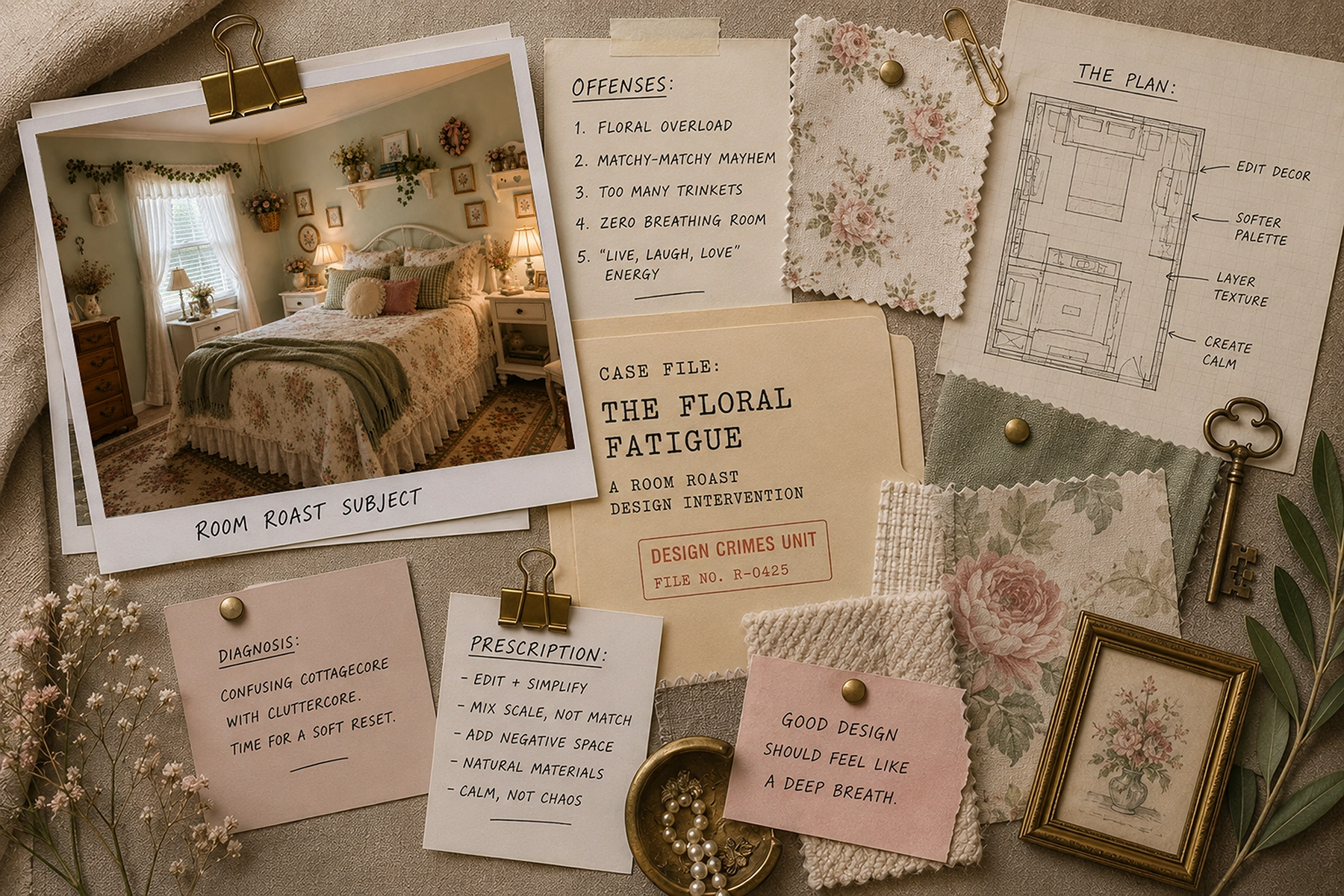
TL;DR: Looking for cottage bedroom ideas? This Room Roast tackles one of the internet’s most misunderstood aesthetics: cottagecore. This cottage bedroom didn’t have bad taste. It had too many good ideas happening all at once. In this cottage bedroom makeover, a hospitality designer breaks down the decorating decisions that made this floral-filled space feel dated—from pattern overload to shelf styling gone rogue—and reveals the transformation that turned it into a modern cottage retreat.
Throwback: it’s 2011. You have just discovered Pinterest, and Pinterest has just discovered florals.
Mason jars are a personality. Every sentence worth saying is being stenciled onto a reclaimed wooden plank. A Yankee Candle named “Home Sweet Home” is slowly burning somewhere. And a woman is hot-gluing a third ruffle onto something that already had two. Burlap is happening. Lace is happening on top of the burlap. And in bedrooms across suburbia, a generation raised on shabby chic is learning the most dangerous lesson interior design ever taught: that if a little floral is sweet, then surely nine florals is a lifestyle.

To be fair, at the time, this was the dream. Rachel Ashwell told us nothing should match too perfectly — so we matched everything imperfectly, in roses, in sage, in dusty pink, over and over until the whole room hummed at one note. Laura Ashley was aspirational. A ruffled bed skirt felt like self-care. And a wall of tiny botanical prints in gold frames said, unmistakably, a woman of taste lives here, and she has opinions about hydrangeas.
And honestly? Some of these rooms still have genuinely good bones.
This roast is not about shaming cottage style. It’s about understanding why one floral room feels like a warm hug from a boutique hotel… and another feels like a gift shop that sells potpourri by the scoop.
Let’s roast this room!
A Quick Note Before the Roast
I roast rooms to make the world a more beautiful place. Also, because decorating should be fun, not a referendum on your worth as a person.
Somewhere between the design shows and the eight thousand nearly identical paint chips, decorating got scary. People treat choosing a nightstand like defusing a bomb. So let me lower the stakes for you right now: it’s a bedroom. You’re allowed to try things. You’re allowed to get it wrong, laugh, and fix it.
That’s the whole point of a Room Roast. Not shame. Not snobbery. Not “your house is ugly.” Just a designer’s eye, a few jokes, and an actual plan. And a heads-up: stick around to the end, because the after on this one is so good.
(Also, yes — every room here is AI-rendered. Roasted by me. I prefer throwing shade at pixels, not people. No actual cottage romantics were harmed in the making of this post.)
What Exactly is a Cottagecore Room Roast?
A Room Roast is my no-shame design teardown: I take a dated room, diagnose exactly why it feels off, and show you how to fix it. This one takes on a cottage bedroom that takes a floral fixation a little too far.
Here’s the game plan. First, I assess the space and take its vitals: the stats, the palette, the era it got stuck in (and where it went off the rails).
Next, I flag what’s working (because something always is) and what isn’t. Then we book the design crimes, one by one. And finally, the good part: the intervention and the reveal.
A check-up, a diagnosis, and a glow-up, in that order.
And if you’re curious to learn more about the modern cottagecore style, be sure to check out my room-by-room guide to this aesthetic here. And also check out my favorite cottage color palettes here.
Want the Redesign Recipe?
I’m about to walk you through a gorgeous reveal you’re going to love.
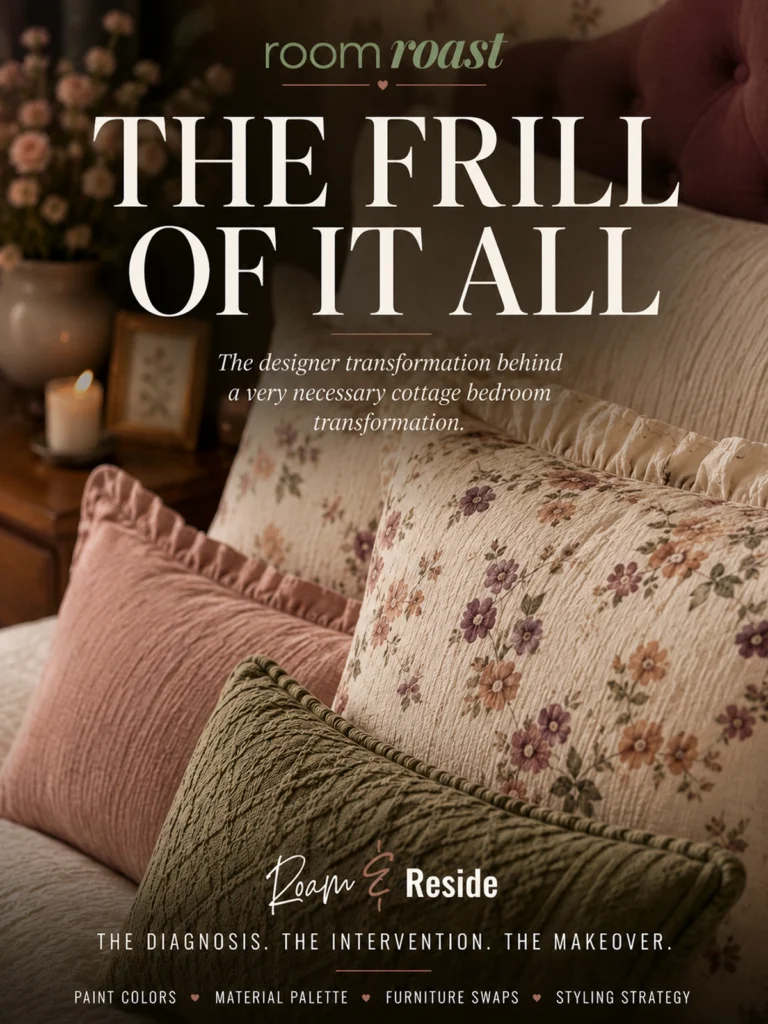
But a wow isn’t a how. So if you want the actual recipe (the paint colors, the swaps, the styling tips), I bundled it into a free For the Frill of It All – Design Fix Guide you can use in your own room.
The Infraction: Why This Cottage Bedroom Feels Dated
Here’s the thing about this room. It is trying SO HARD to be cottagecore. And honestly? That’s exactly what makes it kind of lovable. There’s a sincerity here I genuinely respect. You know somebody stood in this room, arms full of ruffled shams, thought more, and meant it with their whole heart.

The problem isn’t any single thing. Nothing in here is offensive on its own. The problem is that every object showed up to the same party, in the same outfit, talking at the same volume — and nobody was assigned a seat. The roses are negotiating with the gingham. The gingham is negotiating with the rug. The rug gave up years ago. Every surface has been issued a tiny ceramic something, as if the shelves are paid per occupant. And the whole arrangement runs together like a love letter with no punctuation. It’s heartfelt, but you’re three lines in, and you’ve already lost the thread.
This is what happens when a room is decorated by accumulation instead of intention. It’s not bad taste. It’s just all the things, all at once, with no editor in the room.
Getting Started: The Bedroom Assessment
Every roast starts the same way: before I touch a thing, the patient gets a full work-up. Vitals taken, square footage logged, decorating decade established — and don’t worry, the room always confesses. Somewhere between counting the florals and noting that the living-plant count is zero (the ivy, of course, is plastic), the diagnosis writes itself.

And none of it is a crime on its own. That’s the trap of cottage style: every single piece is genuinely lovely, so nothing ever feels like the thing to take away. But lovely times forty stops reading as charming and starts reading as cluttered. The chart isn’t diagnosing bad taste. It’s diagnosing a room that said yes to absolutely everything.
A short history of how this happened
Because this room didn’t come from nowhere, it’s a relic from a very specific moment in time.
The cottage-romantic era peaked when “collected” got confused with “kept.” The instinct was beautiful — fill your home with things you love, layer in softness, make it feel gathered over a lifetime. But somewhere along the way, “gathered over a lifetime” turned into “everything from the HomeGoods clearance aisle, this Saturday.”
Florals stopped being a choice and became a default. The faux ivy moved in and never left. And blank space — the most underrated luxury in design — started to feel like a problem that needed solving with one more wreath.
The result is a room that reads as coordinated but not curated. Cozy but not calm. Full, but never finished — because a room built on “more” can never actually be done. There’s always another shelf. There’s always another bow.
That moment has passed. The room, bless its heart, did not get the memo.
Design Crimes: What’s Causing This Cottage Bedroom To Look Outdated
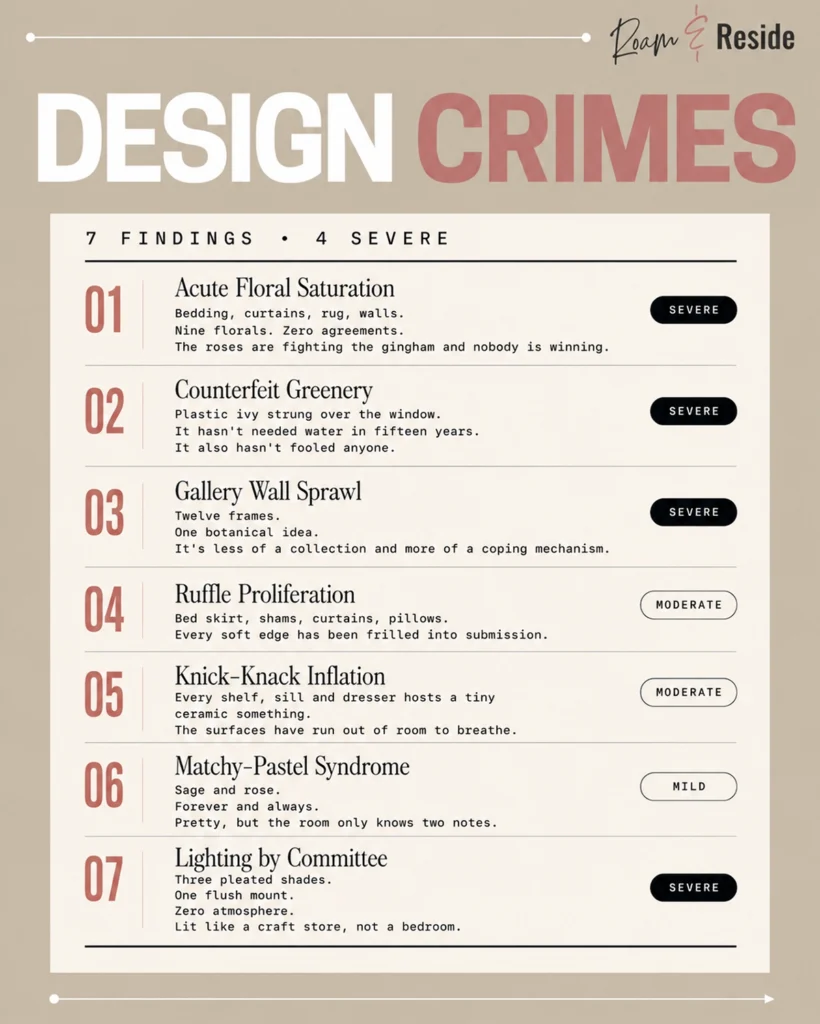
The rap sheet’s on the board. But a few of these deserve their day in court, so let me make the case.
The Crime: Pattern-on-Pattern Warfare.
Cottage style sold us a lie — that florals are “safe,” so you can never have too many. Reader, you can. The moment a second floral enters a room, the two of them are no longer decorating; they’re competing. Add a third and a fourth and a gingham and a quilted vine and you don’t have a cohesive look, you have nine patterns in a hostage situation, and your eye is the hostage. The fix was never “fewer flowers.” It’s one flower, big enough to mean it.
The Crime: The Plastic Ivy That Will Outlive Us All.
There is a strand of faux greenery strung over this window that has been faithfully “growing” since the Obama administration. It has never been watered. It has never needed light. It has also, crucially, never once fooled a single human being who walked into this room. Fake plants promise the cottage look — green, alive, lush — and deliver the exact opposite: dust, a vaguely funereal sheen, and the unmistakable energy of a dentist’s waiting room. Real cottage warmth needs something that’s actually alive, or at least something that isn’t lying.
The Crime: Twelve Frames, One Motif.
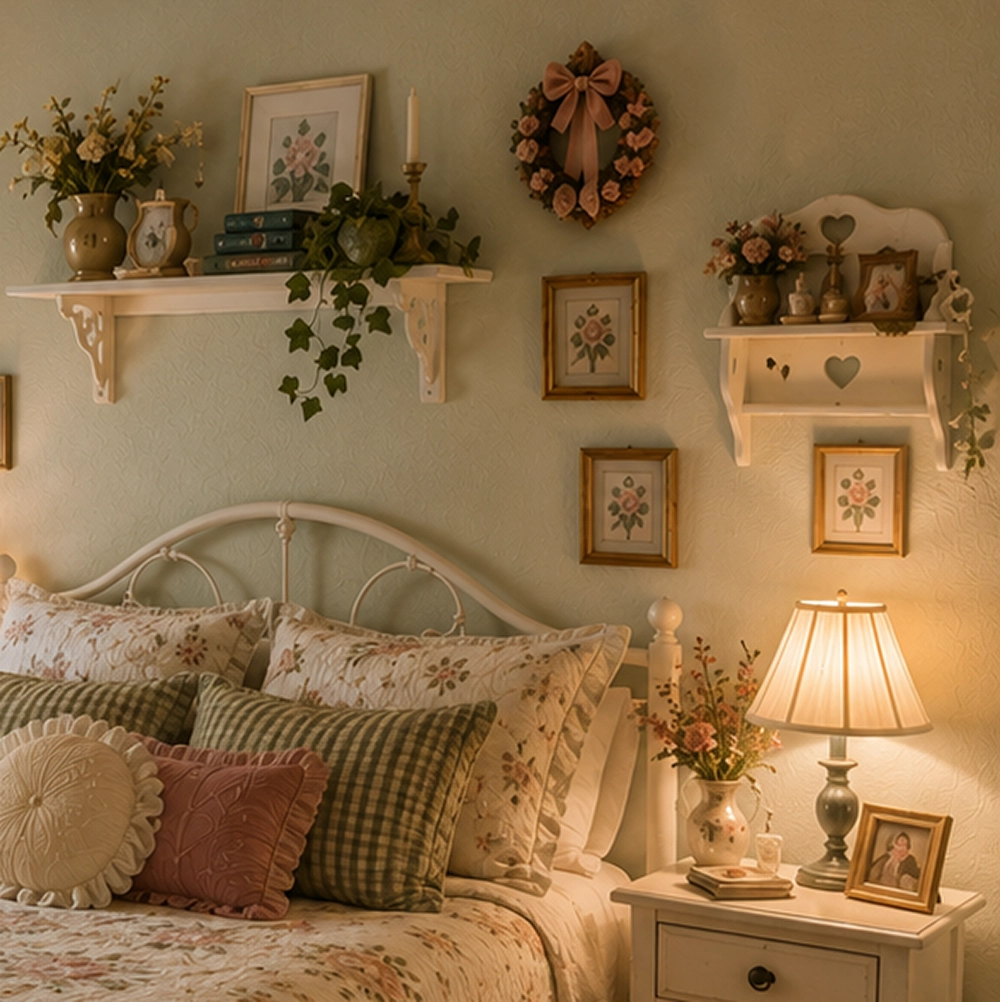
Above the bed hangs a gallery wall of botanical prints — and I want to be clear, a gallery wall is a wonderful thing. This gallery wall is twelve variations on a single floral, hung at the density of a ransom note. When every frame is the same size, the same gold, the same “small painting of a flower,” it stops reading as a collection and starts reading as wallpaper that couldn’t commit. A real gallery wall has range — scale, subject, breathing room. This one just has volume.
The Crime: Fear of the Bare Shelf.
Somewhere this room absorbed the belief that an empty surface is a moral failing. So every sill, shelf, and dresser top has been issued a tiny tenant. But negative space isn’t wasted space — it’s the rest between the notes that lets the music sound like anything at all. A shelf with three beautiful things and some room to breathe will always, always beat a shelf with thirty.
The Crime: Lighting by Obligation.
And then there’s the lighting. Or rather, the room’s complete refusal to have an opinion about it.
Up top: a single overhead flush-mount, the dreaded “boob light,” the most apologetic fixture ever installed, beaming straight down with all the ambiance of a budget-motel hallway.
Below: a couple of tiny table lamps doing their polite, undersized best. And that’s the entire lighting plan. No layers, no glow, no drama, no mood — just enough wattage to confirm the room exists and help you locate your slippers.
This one was lit by obligation, and you can feel it. The room is perfectly bright, and never once gets to be cozy.
Notice the pattern? Not one of these is a taste problem. Every single one is a quantity problem. This room doesn’t have bad ideas. It has too many good ones, and not one of them was ever told no.
The Intervention: How to Modernize a Cottage Bedroom Without Losing Its Charm
There is Hope for the Hopeless {Romantic}.
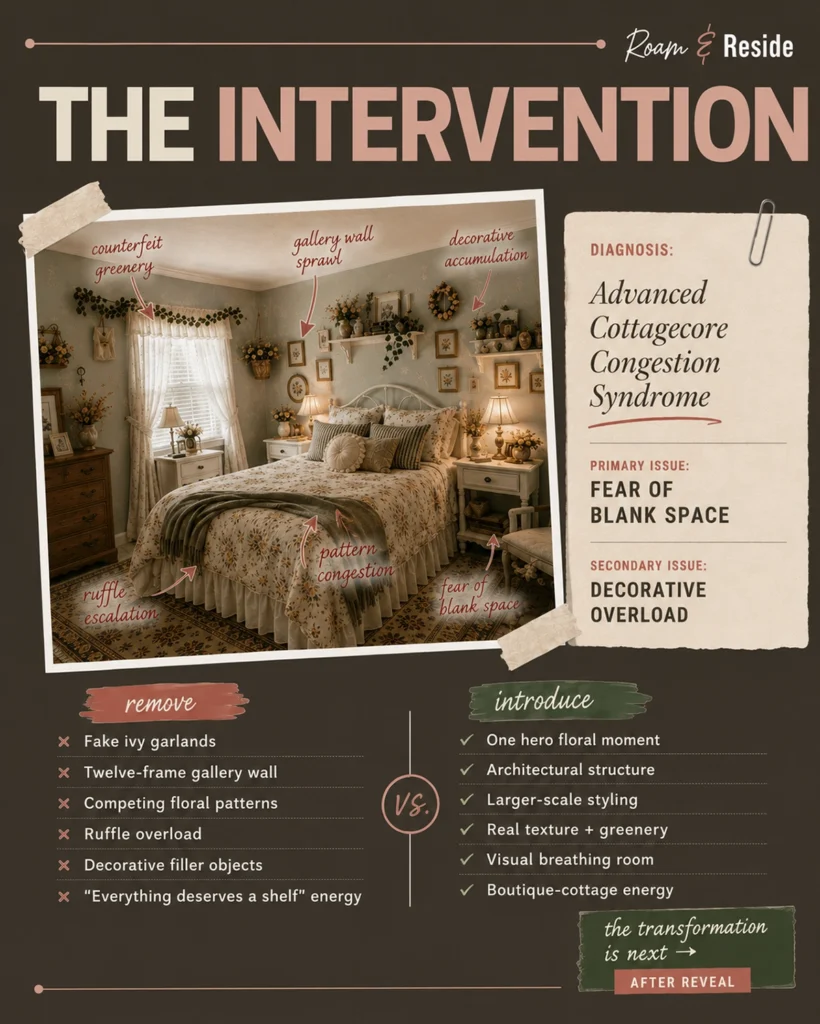
Before anyone panic-orders a dumpster: this room is not a teardown. Underneath all the floral cross-talk, it’s got everything that actually matters — soft natural light, warm tones, sweet proportions, and a genuine point of view. The foundation was never the problem. The problem is everything that got layered on top of it, one heartfelt purchase at a time.
So we don’t gut the personality. We give the personality some room. Subtract the noise, keep the soul. The cottage stays. The clutter goes. And in the empty space that’s left behind, the room finally gets to say one thing clearly instead of forty things at once.
The Cottage Bedroom Makeover Reveal
And here she is, all grown up.
The first thing you notice walking in is that you can finally breathe. Your eye lands somewhere — on the bed, framed and anchored as the focal point, instead of pinballing between twelve frames, a hanging basket, and a wreath all auditioning for attention. The warmth that was always here didn’t go anywhere. If anything, it’s deeper now, because you can actually feel it instead of squinting through the clutter to find it.

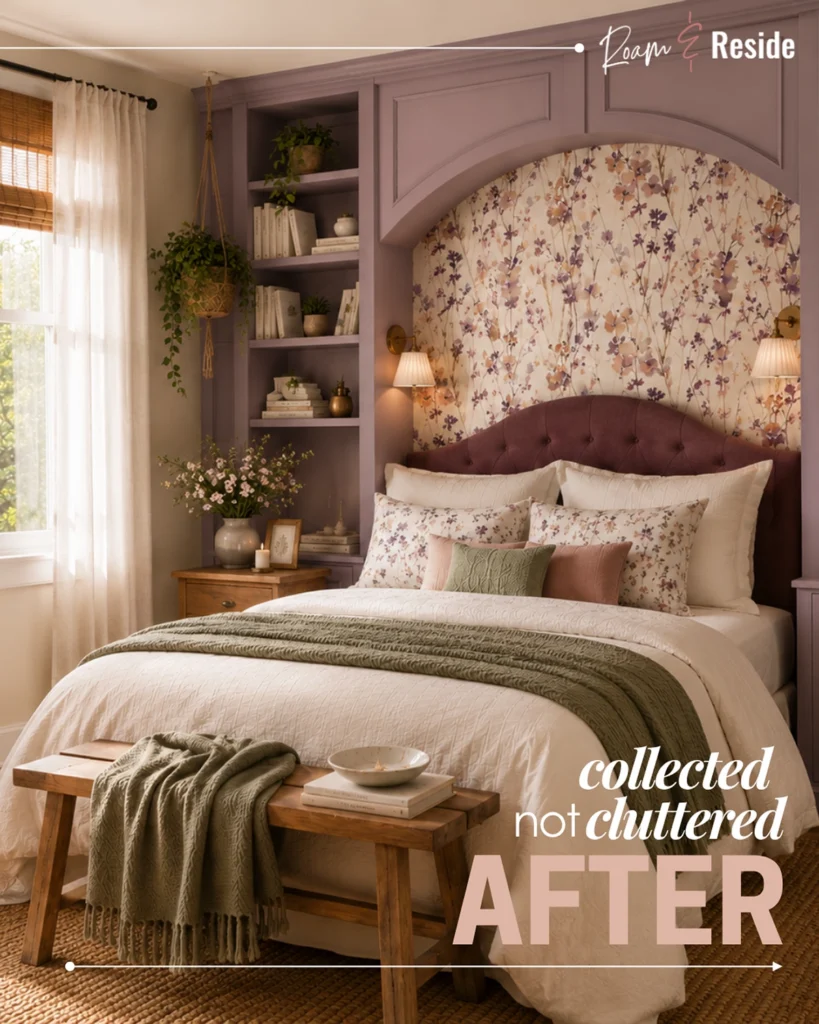
And notice what didn’t happen. She didn’t go cold. She didn’t go minimalist. She didn’t trade her cottage heart for a concrete loft. The florals weren’t banished; they got promoted. One wall, one moment, doing the job, nine were too busy fighting each other to pull off. The plastic ivy quietly retired. And the whole space shifted from “a lot of pretty things in one room” to “one genuinely beautiful room,” which, it turns out, is a completely different thing.
That’s what restraint actually buys you. Not less personality. More of it; finally given enough quiet to be heard.
Same charm. A fraction of the florals. That, right there, is the difference between decorating and designing.


Same charm. A fraction of the florals. That, right there, is the difference between decorating and designing.
Want the Details?
If this makeover made you reconsider your stance on florals, I’ve got good news.
I rounded up the exact paint colors, material palette, and designer swaps behind this transformation into a free Design Fix Guide. Download yours now so you can revisit the ideas you loved without scrolling back through the entire roast.
FAQ’s: How Do You Fix a Dated Cottage Bedroom?
How do you make a cottage bedroom feel modern?
Outdated cottage rooms try to prove they’re cozy by piling on evidence — more florals, more frames, more frills, more figurines, as if coziness were a volume setting. Modern cottagecore does the opposite. It creates that gathered, soulful feeling through real materials and restraint: nubbly linen, a heavy knit, raw wood, stone, one living plant that’s actually thriving, and a deeper accent color to give the soft palette some spine. It says less, and somehow means more.
Is cottagecore still in style?
Yes, but the modern, edited version is the one having a moment. The cozy, collected, nature-loving heart of cottagecore is as beloved as ever. What changed is the discipline. We kept the romance and lost the clutter. Cottagecore isn’t going anywhere; it just finally hired an editor.
Why does my cottage bedroom feel cluttered?
A cottage bedroom usually feels cluttered when every surface, pattern, and accessory is competing for attention. Modern cottage style relies on editing just as much as layering. The goal isn’t fewer meaningful objects—it’s creating enough breathing room for those objects to matter.
Can cottagecore look sophisticated?
Absolutely. The key is balancing softness with structure. Modern cottage interiors pair romantic elements like florals and vintage-inspired details with architectural features, natural textures, and intentional negative space. The result feels collected rather than cluttered.

Why does my cottage bedroom feel dated even though everything in it is pretty?
It’s usually because everything is pretty in the same way. When the florals, the frames, the ruffles, and the trinkets all share the same scale, palette, and energy, the room has no hierarchy — nothing leads, nothing rests. The fix is rarely “buy new things.” It’s editing what’s there, adding texture and contrast, and letting some surfaces sit empty.
How many floral patterns are too many in one room?
A good rule: one hero floral, supported by solids and texture. The room in this makeover had nine competing florals, which is exactly why it read as chaotic rather than charming. If your patterns are arguing with each other, you have too many.
What’s the difference between classic cottage style and modern cottagecore?
Traditional cottagecore leans maximalist — layered florals, ruffles, and collected trinkets on every surface. Modern cottagecore keeps the warmth and nostalgia but adds restraint: one statement pattern, intentional negative space, larger-scale styling, and real materials instead of faux ones. In short, cottagecore collects; modern cottagecore curates.
What colors work for a modern cottagecore bedroom?
Soft, nature-drawn tones with one deeper anchor. Build the base from sage, mushroom, stone, cream, and dusty rose, warmed up with natural wood — then add depth with a moodier accent like plum, burgundy, or mossy green so the palette never reads flat. The trick is contrast: keep it gentle, but never one note.
For my top recommendations for color combinations, see my Cottagecore Color Palette Guide.
The real design crime
If this roast uncovered a few uncomfortable truths, about competing florals, faux ivy that’s seen things, or a shelf that hasn’t seen daylight since 2011 — don’t panic. That’s good news. It means the only thing standing between you and a room you love is a really satisfying edit.
Great rooms don’t happen because someone bought a prettier wreath; they happen because someone made braver decisions. And beautiful rooms don’t start with shopping, they start with clarity.

Before You Buy Another Throw Pillow…
Can I offer one tiny piece of unsolicited design advice?
Most decorating mistakes don’t happen because people have bad taste.
They happen because people start shopping before they have a strategy.
If you’ve ever looked around your bedroom and thought, I know this isn’t quite right, but I don’t know what to do next, this is exactly why I created the Interior Design Starter Kit.
For $9, it’ll help you define your style, identify what’s working (and what’s not), and give you the confidence to make decisions without second-guessing every pillow purchase.
Think of it as your first step before you go all in.
Loving The Cottagecore Look? Here’s Where to Go Next
If this roast struck a nerve, good — there’s a whole world of modern cottagecore that gets the cozy without the clutter. Here’s where to wander next.
Check out my full playbook: what modern cottagecore actually is. This is your room-by-room guide.
→ The Modern Cottagecore Aesthetic
Ever wonder why your “cozy” palette reads flat instead of rich? It’s almost always the color story. These are the combinations that give cottagecore depth instead of one sweet note on repeat.
→ Cottagecore Color Palettes
If you love the romance of cottagecore but want something richer, moodier, and considerably less precious, the dark cottagecore aesthetic may be your jam.
→ Dark Cottagecore Aesthetic
These nurseries strike the perfect balance between whimsical and refined, proving that heirloom style and modern sensibilities can absolutely coexist.
→ Cottagecore Nurseries
Hungry for Another Roast?
Next case file: Florals weren’t the first offense. Before the roses, there was the wrought iron.
If you’ve ever stood in a beige bedroom with a matching furniture set and a giant iron medallion over the bed and thought something’s off but I can’t name it, you’re gonna wanna see this one:
→ The Tuscan Bedroom Room Roast
And if you’re curious to see how the Soft Girl Aesthetic can look with a grown-up glow-up, you’ll want to read this:
→ Room Roast: Bloom Service – An Intervention for an Overgrown Aesthetic
Want to Choose a Decorating Style for Your Home?
Check out this post to help you figure out what look is best for your home.
